

In the rapidly shifting corporate topography of 2026, the traditional pillars of business—capital, product, and technology—have found a new, more volatile foundation: Human Potential. As artificial intelligence flattens organizational structures and global talent pools become increasingly liquid, the role of human resource consulting firms has evolved from peripheral support to central strategic architecture.
For modern enterprises, navigating the complexities of “The Human Element” requires more than an internal HR department; it requires the specialized, data-driven, and culturally nuanced interventions that only top-tier human resource consulting firms like PeopLead can provide
The Strategic Foundations of Human Resource Consulting Firms
To build a skyscraper, you need an architect. To build a multi-billion dollar enterprise, you need human resource firms. These entities specialize in the structural integrity of your organization, ensuring that the “people systems” are robust enough to support your loftiest ambitions.
Organizational Design and Structural Integrity
Modern human resource consulting view an organization not as a hierarchy, but as a living ecosystem. They analyze how information flows, where decision-making bottlenecks occur, and how to flatten structures to increase agility. By partnering with human resource consulting , businesses can move away from rigid 20th-century models and toward “Holacratic” or “Agile” frameworks that empower employees at every level.
The Science of Succession Planning
A leadership vacuum is the silent killer of market cap. Human resource consulting firms implement rigorous, objective, and data-backed succession plans. They use psychometric assessments to identify “High-Potential” (HiPo) leaders three rungs down the ladder, ensuring that the company’s future is never left to chance or “gut feeling.”
Change Management and Cultural Resilience
In 2026, the only constant is disruption. Human resource consulting provide the psychological and operational blueprints for “Change Management.” Whether it is a merger, a pivot to remote work, or a massive digital overhaul, HR consulting firms ensure that the workforce remains engaged, informed, and resilient throughout the transition.
Ethics, Governance, and Board Advisory
At the highest levels of corporate governance, human resource consulting firms act as neutral advisors to the Board of Directors. They establish ethical charters, executive compensation models that align with long-term shareholder value, and ESG (Environmental, Social, and Governance) frameworks that are now mandatory for global investment.
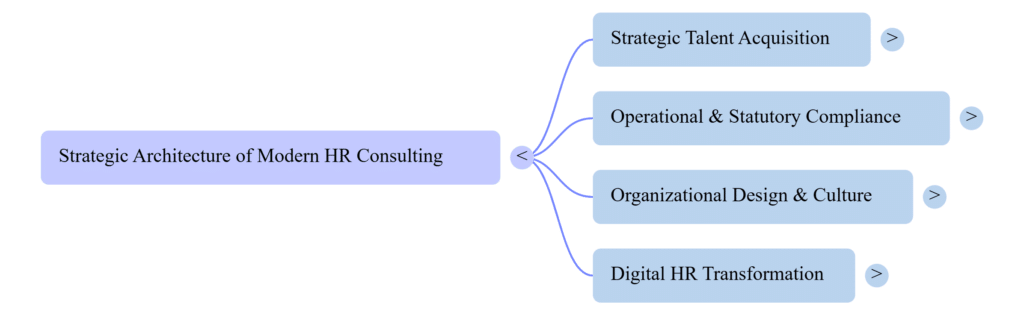
Core Pillars of Human Resource Consulting Firms
1. Strategic Talent Acquisition
Finding the right fit is a science. Human resource consulting firms utilize AI-driven sourcing and psychometric mapping to identify candidates who align with a company’s long-term vision. This reduces the “Cost of Vacancy” and ensures cultural synergy.
2. Operational & Statutory Compliance
The legal landscape is a minefield of shifting labor laws. HRconsulting firms provide a protective shield, managing everything from PF and ESI to POSH compliance, ensuring your business remains audit-ready and legally sound.
3. Organizational Design & Culture
Structure dictates performance. Human resource consulting help flatten hierarchies and design “Agile” workflows. By auditing company culture, they identify and eliminate toxicity, fostering an environment of psychological safety and innovation.
4. Digital HR Transformation
Implementing the right HRIS or payroll system is critical. HR consulting firms serve as technical advisors, integrating automated solutions—like those offered by PeopLead —to create a frictionless employee experience.
Advanced Talent Acquisition via Human Resource Consulting Firms
The “War for Talent” has ended; talent won. Today, HR consulting firms help companies navigate a market where the best candidates are no longer looking for jobs—they are looking for missions.
Developing a Magnetic Employer Value Proposition (EVP)
Why should an elite AI researcher choose you over a tech giant? HR consulting firms help you find the “soul” of your company and package it into a compelling EVP. By highlighting authentic stories, career growth, and purposeful work, human resource consulting firms turn your brand into a talent magnet.
Algorithmic Recruitment and AI Integration
Top human resource consulting firms utilize proprietary AI tools to screen for more than just keywords. They look for “Cultural Add” rather than just “Cultural Fit,” ensuring that your hiring process builds a cognitively diverse team that can solve complex problems from multiple angles.
Neurodiversity and Inclusive Hiring Practices
The most innovative companies of 2026 are those that embrace neurodiversity. Human resource consulting aredesign the interview experience to accommodate different cognitive styles, ensuring that brilliant minds—who might struggle with traditional social interviews—find a place where they can excel.
The Rise of the Fractional and Gig Executive
Not every role needs to be 40 hours a week. HR consulting firms are the pioneers of the “Liquid Workforce,” helping companies integrate fractional C-suite leaders and specialist contractors into their core operations seamlessly.
The Technological Revolution Led by Human Resource Consulting Firms
The “HR Tech Stack” is now the backbone of the employee experience. HR consulting firms act as the digital sherpas, guiding companies through the blizzard of SaaS options to find the perfect fit.
HRIS Selection and “Single Source of Truth”
Data fragmentation is the enemy of efficiency. HR consulting firms help organizations select and implement Human Resource Information Systems (HRIS) that consolidate payroll, performance, and recruitment into a single, real-time dashboard.
People Analytics and Predictive Modeling
What if you could predict which employees were going to quit before they knew it themselves? HR consulting firms use “Predictive People Analytics” to identify flight risks and disengagement hotspots, allowing management to intervene proactively.
Virtual Reality (VR) Onboarding and Training
In a remote-first world, how do you build a sense of belonging? Human resource consulting firms are implementing VR-based onboarding experiences that allow a new hire in Bangalore to “walk through” a virtual representation of their London headquarters, fostering immediate connection.
Cybersecurity and the Human Firewall
The greatest cybersecurity risk isn’t a hack; it’s a human error. Human resource consulting firms work with IT teams to design training and protocols that turn employees into the company’s first line of defense against social engineering and data leaks.

Cultural Engineering and The Employee Journey
If strategy is the car, culture is the fuel. Human resource firms are the “fuel chemists” who ensure your company culture is high-octane and clean-burning.
Psychological Safety and Innovation Cultures
Without psychological safety, innovation dies. Human resource consulting firms conduct audits to measure how safe employees feel to speak up, fail, and experiment. They then implement frameworks that reward courageous thinking over quiet compliance.
Holistic Wellness and Burnout Prevention
In 2026, wellness is not a yoga class; it is a business strategy. Human resource consulting design comprehensive wellness ecosystems that address financial literacy, mental health, and physical vitality, directly reducing absenteeism and healthcare costs.
Total Rewards and Gamified Recognition
Standard bonus structures are often outdated. HR consulting firms create “Total Rewards” systems that offer hyper-personalized incentives—from extra PTO to student loan assistance—ensuring that every generation in the workforce feels uniquely valued.
The Employee Experience (EX) Designer
Top HR consulting firms now employ “EX Designers” who map every touchpoint an employee has with the firm—from the first LinkedIn message to the final exit interview—ensuring the journey is frictionless, respectful, and empowering.
Compliance, Risk, and The Legal Shield
In an increasingly litigious and regulated global market, HT consulting firms provide the “Legal Shield” that keeps your business operational.
Navigating Global Labor Law Complexity
Managing a team across 15 different countries? Human resource consulting firms provide localized legal expertise, ensuring that your contracts, leave policies, and tax withholdings are compliant with every jurisdiction, from the EU to Southeast Asia.
Audits, Pay Transparency, and Equity
Pay transparency is becoming a global legal standard. HR consulting firms conduct “Pay Equity Audits” to ensure there are no gender or racial pay gaps, protecting the company from lawsuits and ensuring a culture of fairness.
The Economic ROI of Human Resource Consulting Firms
Why should a CFO invest in human resource consulting firms? Because the ROI is quantifiable and massive.
- Reducing Turnover Costs: Replacing a senior executive can cost 200% of their annual salary. HR consulting firms cut turnover by 20-30% through better engagement and selection.
- Optimizing Labor Spend: By identifying “Role Redundancy” and improving organizational design, human resource consulting firms can often reduce total labor costs by 10-15% without mass layoffs.
- Increasing Productivity: Engaged employees are 21% more productive. Human resource unlock this latent value through better management training and culture building.
- Risk Mitigation: A single major labor lawsuit can cost millions. The preventative audits performed by human resource consulting firms pay for themselves a hundred times over in “avoided costs.”
Strategic Points of Excellence: The PeopLead Advantage
To understand why PeopLead is consistently ranked among the top human resource consulting firms, one must look at the specific, actionable value points we bring to the table. Our methodology is built on a foundation of “People Cohesion”—a philosophy that ensures every HR intervention is a lever for business growth.
Advanced Talent Acquisition and Sourcing Engines
While traditional HR consulting firms rely on active job seekers, PeopLead utilizes AI-driven sourcing engines to identify “passive talent.” We proactively reach out to the top 1% of professionals who may not be looking but are the perfect fit for your mission-critical roles.
- Agentic AI Sourcing: Using autonomous agents to screen for actual capabilities rather than just academic degrees.
- Psychometric Mapping: We employ deep behavioral testing to ensure candidates possess the emotional intelligence required for your specific industry stress levels.
Comprehensive Lifecycle Management and Automation
We go beyond the “hire” to manage the entire “stay.” As one of the most tech-forward human resource consulting , we implement digital ecosystems that automate the mundane, allowing your leadership to focus on the monumental.
- Digital Onboarding: Frictionless, paperless integration that makes new hires feel like part of the team from day one.
- AI-Powered Performance Systems: Replacing the outdated annual review with real-time feedback loops integrated into your daily workflow.
Bulletproof Statutory and Regulatory Compliance
In the high-stakes world of labor law, PeopLead acts as your corporate shield. Among human resource consulting , our precision in handling Indian and global labor codes is unmatched, protecting you from the financial ruin of non-compliance.
- PF & ESI Management: 100% accurate monthly filings and contribution management.
- Labor Law Audits: Regular “health checks” of your facilities and documentation to ensure you are always audit-ready.
Strategic Workforce Planning and Scaling
We don’t just solve today’s problems; we anticipate tomorrow’s challenges. Our consultants provide the “Predictive Labor Market Forecasts” that allow you to budget and scale with confidence.
- Skill-Gap Analysis: Identifying the “Skills of 2027” your team needs today to remain competitive.
- Succession Planning: Building a “Leadership Bench” so that your company’s growth is never stalled by a sudden vacancy in the C-suite.

The Holistic Framework for Operational Excellence
While technical skills and strategy form the foundation of a business, the invisible frameworks that govern daily interactions are what determine long-term sustainability. Achieving peak operational efficiency requires a multi-dimensional approach that addresses the psychological, logistical, and social components of the workplace.
By focusing on these five pillars, organizations can create a self-sustaining ecosystem where both the business and its individuals thrive in harmony.
1. Emotional Intelligence in Leadership
True leadership in the modern era has shifted from command-and-control to empathy-and-influence. Leaders who possess high emotional intelligence are better equipped to navigate team conflicts, provide constructive feedback, and inspire loyalty. By fostering a leadership style rooted in self-awareness, organizations can reduce internal friction and build a culture of mutual respect that transcends traditional hierarchies.
2. The Architecture of Flow and Productivity
Efficiency is rarely the result of working harder; it is the result of working smarter through optimized workflows. This involves analyzing the “friction points” in a typical workday—unnecessary meetings, redundant communication channels, and fragmented task management. By streamlining these processes, teams can enter a state of “flow,” where high-value work is completed with less cognitive fatigue and greater accuracy.
3. Resilience and Mental Fortitude Training
In a volatile market, the ability to bounce back from setbacks is a critical organizational asset. Beyond basic wellness, businesses are now investing in resilience training that teaches employees how to manage stress, adapt to sudden changes, and maintain focus during crises. This proactive approach to mental fortitude ensures that the workforce remains stable and productive even under extreme external pressure.
4. Knowledge Management and Institutional Memory
One of the greatest risks to any growing entity is the loss of information when key personnel depart. Establishing a robust system for knowledge management—where processes, insights, and historical data are documented and easily accessible—ensures that the “brain power” of the company remains an evergreen asset. This creates a legacy of learning that empowers every new hire to succeed faster.
5. Purpose-Driven Alignment and Vision
Employees today are increasingly motivated by a sense of contribution rather than just a paycheck. When an individual’s personal values align with the broader vision of the company, engagement levels skyrocket. Organizations that clearly articulate their “Why” and integrate it into every project create a unified front where everyone is pulling in the same direction with authentic passion.
Frequently Asked Questions
1. How do human resource consulting firms differ from headhunters?
While headhunters find people for roles, human resource consulting firms fix the roles, the culture, and the strategy. Headhunters are transactional; HR consulting firms are transformational.
2. Can a small startup afford human resource consulting firms?
Yes. Many HR consulting firms offer “Fractional HR” services. You don’t need a full-time CHRO; you need 10 hours a month of high-level strategic advice from human resource consulting firms to ensure you build your foundation correctly.
3. How do human resource consulting firms handle remote/hybrid work?
They provide the policies, the tech stack, and the cultural frameworks to ensure remote workers are just as engaged and productive as those in the office. They solve the “Out of Sight, Out of Mind” bias.
4. What is the role of human resource consulting firms in Mergers & Acquisitions?
They conduct “People Due Diligence.” They look at cultural compatibility, leadership overlap, and benefits harmonization to ensure that the merger actually delivers value instead of imploding due to cultural friction.
5. Why should I choose PeopLead over a “Big 4” consultancy?
Specialized human resource consulting firms like PeopLead offer more agility, direct access to senior experts, and a more personalized, bespoke strategy that massive, “cookie-cutter” consultancies often cannot provide.
Conclusion: Designing the Future of Work
As the corporate world moves toward an era defined by rapid technological integration and evolving social contracts, the strength of an organization is no longer measured solely by its balance sheet, but by the vitality of its internal community. Success in this new landscape requires a proactive shift from merely overseeing personnel to intentionally designing environments where talent can flourish. By focusing on the intersection of data-driven insights and genuine empathy, businesses can build a foundation that is not only resilient to market fluctuations but is also a magnet for high-caliber individuals.
The journey toward creating a world-class workplace is continuous and requires a partner who understands that every policy, technological tool, and cultural initiative is a building block for the future. When leadership prioritizes the growth and well-being of its workforce, the result is a self-sustaining ecosystem of innovation and loyalty. Ultimately, those who view their collective talent as a primary driver of value—rather than a secondary concern—will be the ones who lead their industries with confidence and clarity in the years to come.